
big feelings
music, image, catharsis, & hyperpolitics

Many musicians have stories about a time when a mentor made them cry. Teachers can be cruel. They can be tasked with delivering hard truths. (“You are not a pianist. You are a piano operator,” growled the legendary Polish emigré Jakob Gimpel at my then-fourteen-year-old father. My dad got over it, winning the Artur Rubinstein Competition a dozen years later and proving, throughout his long career, to be more of a poet than a pile driver.) Teachers may also inadvertently catch a pupil at a moment of psychological fragility. Here, an array of small personal crises—a bad break-up, a lost nannying job, a chronic bedbug infestation—may conspire to make an otherwise innocuous bit of criticism (“I think that B-flat could be slightly longer”) result in an unmitigated emotional meltdown.
A few days ago, I cried in a classroom. But it wasn’t a teacher who made me weep. I was the teacher. And it was four students at the University of Iowa who, during a string quartet coaching, brought me to tears.
The five of us sat in a sun-drenched studio on the third floor of the Voxman Music Building, where I was to hear American Studies, which I’d originally written for Brooklyn Rider. Rooted in themes from a song called “To Be American,” it’s a tricky piece studded with rhythmic and harmonic treachery. As the students began to play, I was swiftly won over by the group’s rhythmic confidence. Without breaking a sweat, they navigated rapidly shifting meter changes in what was, all in all, a formidable performance. And yet these young musicians seldom looked at each other, while shifts in character and mood seemed to elude them.
When I coach chamber music, I often dive headlong into the nitty-gritty, offering suggestions having to do with phrasing, harmony, intonation, or color. But in this encounter, I had an instinct to try something different. With my friend Jeremy Denk in mind—he has an outsized gift for expressing musical ideas through image or metaphor—I suggested to the quartet that we break the piece into scenes, and then describe, in nonmusical terms, the action within each one.
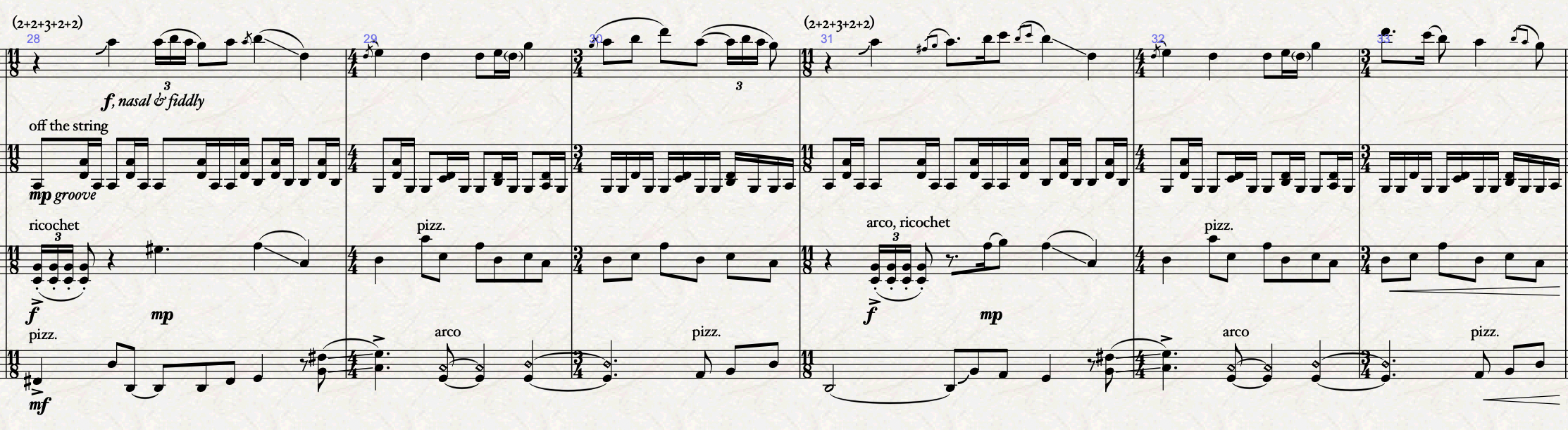
We agreed that the opening statement, in which violins chatter astride a jocular dance in the lower voices, was all light and sunshine, a frolic in a field. A wedding had just taken place on a rented farm. Between the ceremony and dinner, a group of guests had taken up party games on a sprawling expanse of grass: corn-hole, ring toss, frisbee. No thoughts of flights or rental car returns or heading back to the office on Monday. Just pure joy.
Scene change: a transition presents itself in the form of a small melodic cell—a descending, dotted figure—which is repeated several times, its rhythmic identity remaining mostly stable as the harmonic ground shifts underneath. The quartet is asked to play at a healthy dynamic until a sudden pianissimo augurs a shift in tone.
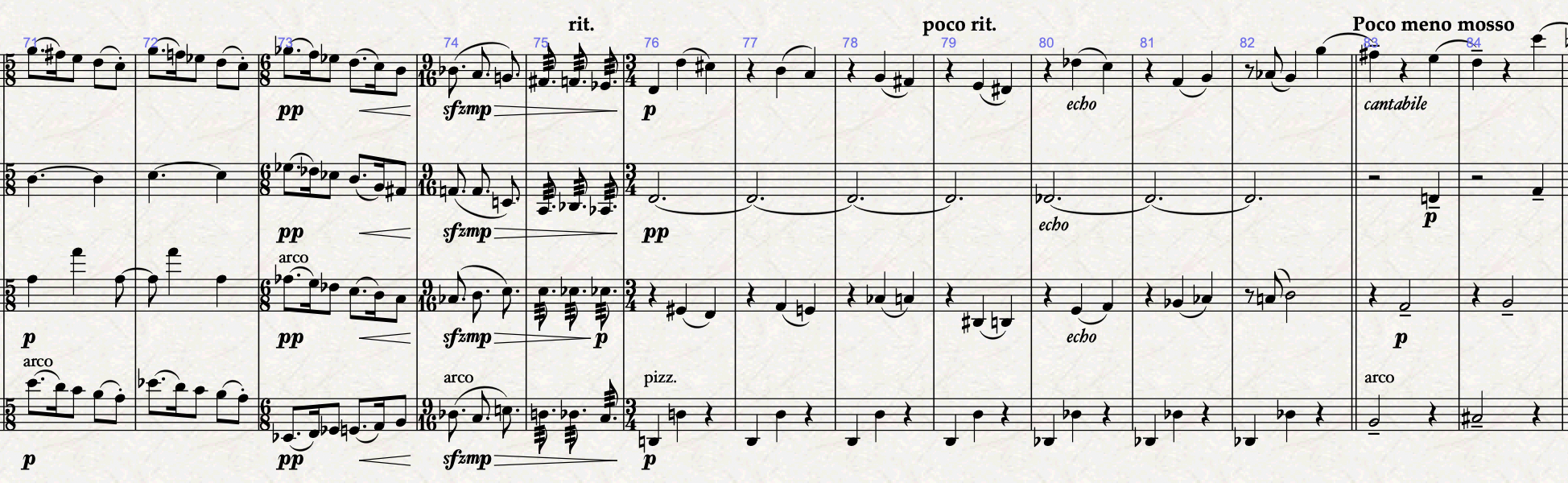
When the students played this passage the first time, they steamrolled through the pianissimo and the character change that ought to have followed. We spoke about the music a bit more and decided that the pianissimo arrives as the wedding revelers discover a gap between two boards in a barn just beyond the tent. A strange light shone through the space between these warped wooden planks; as the transition progressed, the revelers would slip through the boards, making their way into the barn, where a glowing, golden sofa awaited them.
The students tackled the transition again, and now, making eye contact, directed their energy toward each other. Here, the pianissimo arrived with a well-wrought sense of drama. Engaging their collective imagination, the ensemble tightened technically, too: rhythm and attack were now more unified, a reminder that expression and technique do not exist in distinct realms.
The second episode of American Studies takes the tune and twists it, hammering once-pure harmonies with sour notes and angular sonorities. I suggested that as the revelers sat down on the golden sofa, the micro-dosing they’d been subjected to (!?) during pre-ceremony drinks would start to kick in and that a slinky cat in a pink tuxedo would now appear and commence a lecture on continental philosophy.
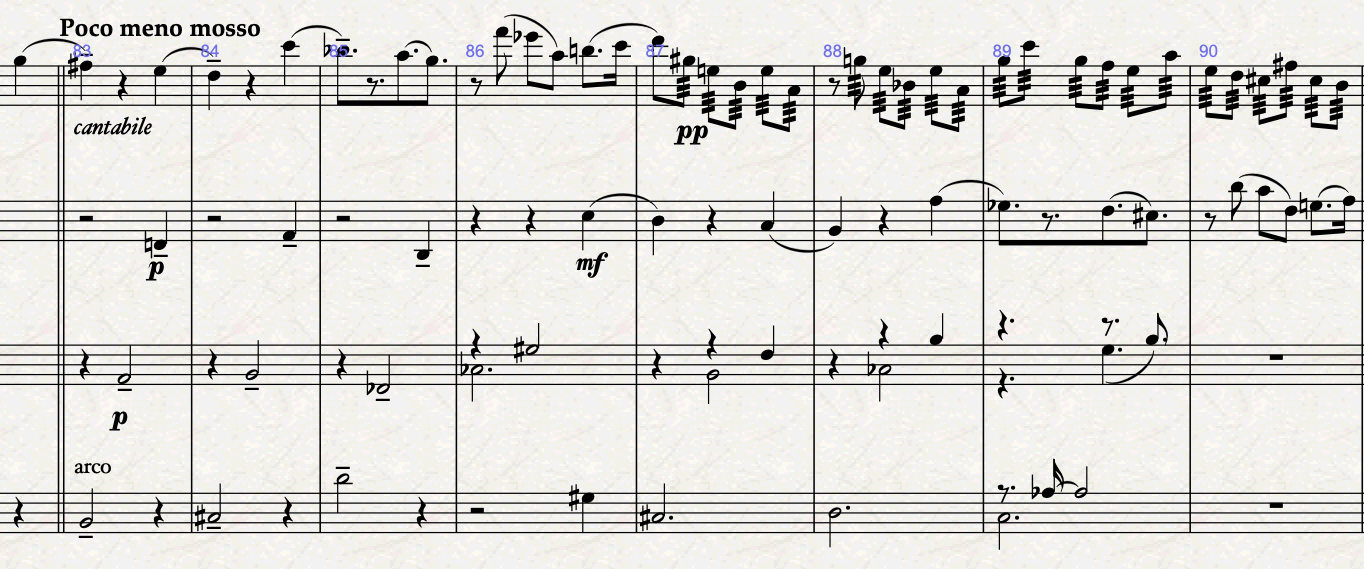
When the quartet took another stab at this section, their playing became even more dynamic. Unbidden, the violinists introduced sultry slides between notes; I could picture the cat in its pastel finery. I asked the students to stop and spoke a few words of encouragement. It was at this moment—having only minutes prior offered the group an absurd image to hold in their minds—that I began to cry.
Why? If nothing else, I’ve been feeling tender for days. Two-and-a-half weeks into a three-week jaunt away from home, I miss my wife and children. I miss the smell of the soil in our garden after it’s rained. The hotel check-in routine has taken on a grating, Groundhog Day-like quality. And that’s not to speak of the wider world, the sense that we’re all being force-fed a surfeit of bad news that we’re unequipped to hold.
But in that practice room, watching these four musicians draw closer to one another, closer to the music, I felt alright. I was alert to the social dimension of music, which, at its best, allows us to become more aware of each other’s humanness. Ultimately, though, what made me cry may simply have been a sense of agency: of having helped to make something—even a dinky ten-minute string quartet—a tiny bit better. At a moment when the feeling of powerlessness is often paralyzing, the coaching reminded me that modest local acts (of service, of art-making) with immediately palpable results may keep us sane.
This will strike some as self-evident. But it bears repeating in an era of hyperpolitics, a coinage popularized by the Belgian historian Anton Jäger, whose book of the same name has just been published in English. Jäger offers a concise analysis of political life over the last century, mapped onto two axes: an x-axis describing politicization (how politically engaged a population is), and a y-axis describing institutionalization (the extent to which a society is engaged with trade unions, social clubs, religious organizations, membership-based political parties, and so on).

Hyperpolitics refers to an era in which everything is political, even as social capital—as the term was used by the sociologist Robert Putnam in his classic Bowling Alone—is at an all-time low. Union membership in the U.S., for example, hovers around 9%, a more than two-fold decline since the early eighties. At the same time, participation in social clubs and religious organizations has plummeted—with the notable exception of the evangelical church. In 2023, the U.S. Surgeon General declared an epidemic of loneliness and social isolation.
Meanwhile, the barrier to entry for political participation has never been lower, which, counterintuitively, may explain why so much activism rooted in the internet has proved to be ineffectual: without robust social, professional, or religious bonds anchored to the physical world, it’s difficult for movements to sustain themselves. As Jäger writes, “for fledgling social movements operating in debt-driven service economies, the solidarities of the online world remain an insufficient replacement for those of the local community and workplace.” In this sense, engaging one’s local community isn’t just a way of creating a sense of agency. It’s also a means of rebuilding the social bonds necessary to revive sustainable networks built for societal transformation.
I take Jäger’s book as an urgent call to action. Anything we can do to restore communal bonds, to foreground the group rather than the individual, will help us build the organizations necessary to meet this confounding political moment. Ours is an era of ideological dealignment, one in which antiquated conceptions of left and right are collapsing in the wake of generational drift, opening up new opportunities for class-consciousness oriented toward a rejection of oligarchy. As techno-accelerationists rush feverishly toward an AI-based world that marginalizes human agency and creativity, we need—now more than ever—a durable movement with which to fight back.

Thank you all for reading, and to paid subscribers, for helping this publication to thrive. As a reminder, liking, sharing, or commenting helps posts to become more visible to others, so smash those various buttons as you see fit. In case you missed it, my new album, Elevator Songs, a collaboration with Grammy-winning vocal ensemble Roomful of Teeth, is now available for pre-order via Bandcamp. (For customers outside the United States, you’ll get much more competitive shipping rates via Burning Shed.) Lastly, I’ll be on tour with Roomful of Teeth in the U.S. in April. And if you’re in Iowa City this weekend, please stop by the final performances (for a while) of my solo musical plays, Magnificent Bird and Book of Travelers; dinner will be served in between! Tickets and information for all dates can be found here.

Great piece, really inspiring. And I'm reminded that the renowned piano teacher Theodore Leschetizky called the teenaged Paul Wittgenstein (before he lost his arm) "the great key smasher," which likely sounds even worse in German.
moving writing Gabe! xoxo