
streaming & crying: a polemic
You cannot claim to be pro-labor and stream music

A few weeks ago, Anastasia Berg published an extraordinary essay in The Point, meditating on a now infamous conversation between journalist Jia Tolentino and political commentator Hasan Piker. In a joint interview, Tolentino and Piker averred that shoplifting is okay, actually, because the oligarch class steals wages from us plebes on the regular. Berg writes with unwavering moral clarity about l’affaire Whole Foods, likening the pair’s defense of “microlooting” to the Hebrew phrase yorim ve bochim, or “shooting and crying.” From the Six-Day War through the catastrophe in Gaza, she explains, it has not been uncommon for IDF soldiers and Israelis to express remorse about their own conduct and that of the military. “The implicit idea,” writes Berg,
is that the crying and the shooting might as well be contemporaneous. This is because, while in individual cases those accused of shooting and crying might have been expressing genuine moral contrition… collectively, a certain kind of crying enables rather than curbs moral disaster. This is the kind of crying that is calibrated to express regret not for what one has done and should not have done so much as for what one, regrettably, had to do… [T]he professed “moral injury” to self turns the perpetrator into a victim (cf. “It is so hard to live ethically in an unethical society”). The problem with shooting and crying is that all too often you are not really crying for anyone but yourself.
(emphasis mine)
I want to print this out and put it on my wall, to scream it from the rooftop, to tattoo these words on my forehead. And when someone tells me that they know how awful Spotify is, but that they just can’t part with the playlists they worked so hard to create, or that they can’t afford to buy all the music they love, I want to say, “fine—but please acknowledge that you are shooting and crying.” Or perhaps, I should say, streaming and crying.
There are, no doubt, ways in which it is difficult to “live ethically in an unethical society.” When it comes to shooting and crying, I am as guilty as the next. My job “requires” me to fly constantly, and I lament my complicity in the tons of CO² spewed into the atmosphere of our gasping planet. In other areas, I have opted out of engaging with problematic firms—I don’t, for example, shop at Amazon—but for rural Americans faced with the decline of small-town retail, the company serves as a lifeline for basic goods.
Yet the phrase “there is no ethical consumption under capitalism” breaks down completely in the realm of music. What prevents consumers from paying musicians for their labor is not the capture of the industry by dirty money, but rather, sheer entitlement: that is, the belief that frictionless access to all music at all times is a right. Last year, I argued against streaming, not from an economic standpoint but from the viewpoint that choice paralysis—access to a library containing hundreds of millions of songs—leads many of us to become lousy listeners. Here, I want to make not merely an economic argument, but a moral one: if you claim the mantle of pro-labor politics while continuing to stream music, your commitment to those values is not worth the DSA patch on your backpack. You are, instead, shooting and crying.
Consider this: you would not parade through the restaurant district of your city, gliding through the door of a quaint family-owned trattoria, taking a few bites of pasta, running your finger through a slick of whipped ricotta, licking a plate of octopus, and leaving a few pennies on the table before moving onto the French bistro down the block, where you might allow a few oysters to slip down your gullet (to be washed down with a nice Muscadet; another coin or two left on the counter), and then onto the Tibetan momo joint around the corner, and so on.
For any number of reasons, you would never do this. First of all, we don’t expect to dine lavishly for pennies. We know the kitchen staff is back there, trimming vegetables, peeling garlic, washing dishes, plating pork chops. Surely we understand that paying $0.0035 per bite would not come close to covering the restaurant’s labor costs. And then there’s the fact that we can eat only so much before, like Mr. Creosote in Monty Python’s The Meaning of Life, a wafer-thin mint might cause us, quite literally, to explode.
And yet, when it comes to music, millions, daily, do something not unlike what I’ve just described. It is an economic model that has been sanctioned by streaming services and major record labels without the consent of artists. It is technically legal, and patently exploitative. When streamers protest that they “cannot afford to purchase all the music they listen to,” they are acknowledging that concern for the fair compensation of artists has been supplanted by the societal norm of constant, passive listening. But you, the listener, may choose to protest this state of affairs, one in which music, through its increasing ubiquity, is at once degraded and devalued.
Just how devalued is music? Let us begin by asking what it costs to make an album today. Budgets vary wildly, but for the sake of argument, let’s take a conservative (i.e. medium-low) estimate.1 What follows is a hypothetical budget for a singer-songwriter, with day-rates set somewhat lower than what one might find in New York or Los Angeles, but which would likely be appropriate elsewhere. My point here is to demonstrate that even for albums made thriftily, streaming royalties are akin to wage theft.
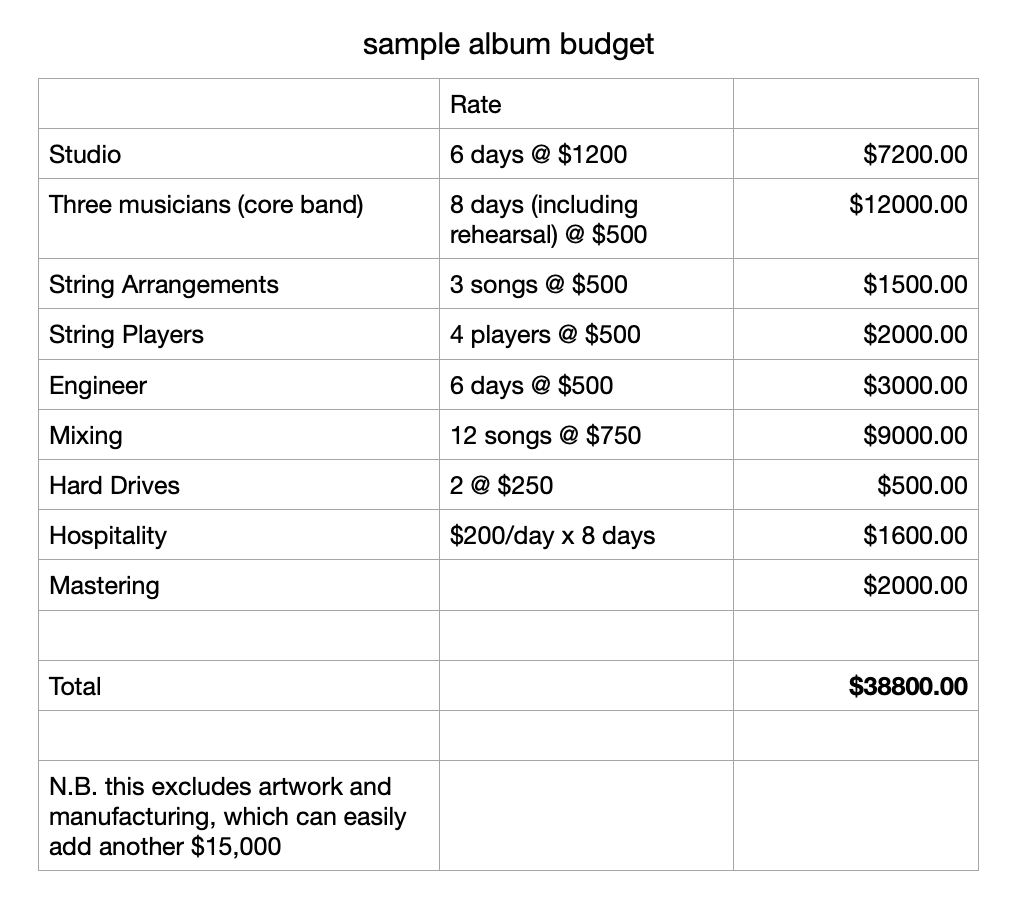
Now, if the average streaming royalty comes out to roughly $0.0035 per stream,2 then a self-releasing artist would need around 11 million streams—or 1 million plays of the complete album (presuming 10-11 songs)—to break even on that $38,800 budget. And that’s before she’s able to per herself a dime. By contrast, if the sale of a single album nets roughly $9,3 she would need to sell 4,300 records to break even. By this measure, each sale is equivalent to roughly 230 streams of the entire album. The question I would ask is this: can you point me to an album you’ve listened to 230 times, start to finish? Probably not. But let's say you’ve listened to your favorite record 50—or even 100—times. That still suggests that an artist whose songs mean so much to you is, at best, receiving 25-50% of what they would have been paid had you purchased their album. The more casual the listening, the more dismal the numbers: listening to a record front-to-back ten times might result in 5% of the pay an artist would have received from a single sale. (This isn’t actually how streaming royalties are dispersed; the reality suggests an even grimmer picture.)4
In sum, streaming has not merely redirected revenue from one format to another. It has led, rather, to lower levels of artist compensation while exacerbating inequality between megastars and everyone else. Even as those at the very top draw eye-popping streaming royalties, most artists make less than they did in the pre-streaming era. This state of affairs stems simultaneously from the formula by which streaming services pay out royalties, which rewards on-repeat, passive listening; the dominance of opaquely curated playlists, which artificially boost streams; and the influence of the three major record labels, which, in some instances, hold equity stakes in streaming services, and whose power to shape algorithms and playlists remains shrouded in secrecy. Taken together, these factors suggest a twisted landscape in which a three-minute song streamed fifteen times in a row is deemed more valuable than a forty-five-minute symphony listened to once.
Admittedly, the headwinds are strong, and streaming isn’t going anywhere. For many, the album itself is a thing of the past; artists like me are increasingly cobwebbed relics of a bygone era. So yes, if you are a happy capitalist, by all means, stream away! But for those who are troubled by inequality, who believe in worker power, and would have their lifestyle better reflect their values, music is an area in which it is entirely possible to limit one’s consumption to reflect the labor required to produce albums.
I stopped streaming a little more than a year ago. I detailed the evolution of my listening habits over the course of three essays, which you can explore here, here, and here. For those interested in reforming their own relationship to recorded music, I suggest allocating a manageable monthly budget, and putting in quality time with each of a handful of titles that you purchase; Bandcamp and/or the merch table remain the most artist-friendly means of doing so. If your experience is anything like mine, you may find that the quality of your listening, and the relationships that you develop to individual albums, will deepen and improve. Beyond that, you’ll have the satisfaction of knowing that your money is going directly to artists you admire.
For the sake of transparency, my solo albums have cost anywhere from $24,000 (Book of Travelers) to $125,000 (The Ambassador) to make. The rest have fallen somewhere in between.
Streaming royalties vary widely, with YouTube paying the least ($0.002/stream) and niche services like Qobuz paying the most ($0.018/stream); Spotify sits in the middle ($0.0035/stream).
I’ve averaged profit across formats: a digital album on Bandcamp that sells for $9 nets around $7; a compact disc nets between $6 and $10 after manufacturing/wholesale costs, while a vinyl record sale can net anywhere from $13 to $19.
Many streaming users believe that the monthly fee they pay is distributed proportionately amongst the artists to whom they listen. But with the pro-rata model used by most services, subscription dollars instead flow disproportionately to viral hits. Without getting into equations, suffice it to say this: the consumer who streams music constantly — their laptop playing music 12-18 hours a day, whether or not there’s anyone to hear it — has a disproportionate impact on the allocation of royalties relative to the consumer who listens to one or two albums a day with focus. For more on the difference between pro-rata and user-centric models, I recommend this very useful primer.
My new album, Elevator Songs, a collaboration with Roomful of Teeth, is out now. You can listen & purchase here. My tour dates are here. As always, thank you for reading, and to those with paid subscriptions, for making this publication possible. If you’re not in a position to upgrade, please consider liking, sharing, or commenting on this post, which will help it become visible to others.
I've always believed that artists deserve to be paid for their art. My simple ape brain just understood the correlation between "artist have no money, artist make no art. Steve not get art to enjoy." So when I ran out of room for CD's I started buying albums on iTunes.
Then 15 years ago I began a relationship with my now wife, who is a lifelong professional musician. I saw the size of her royalty payments and it became intensely personal to me. So now I buy first directly from the artist, if possible. Second, from Bandcamp and finally, from ITunes.
I've never streamed and I am only one of two people, professional musicians included, who I know that don't. But before I demand a merit badge, let me say that I'm still a horrible human because I buy from Amazon. I'm ashamed, but I do it.
Thanks for writing this, Gabriel! It's a good reminder and the restaurant analogy is excellent. I TRY to only listen to music that I've bought, but these goddamn streaming services make it so, so easy to fall off the wagon. The arbitrary rules I set up for myself are: I pay monthly for Apple Music but only stream artists that are either filthy rich or dead, or albums that I've bought on vinyl. I also budget around $100 to drop every Bandcamp Friday. Wish I could spend more, but alas, freelance photographers don't make much money either.